
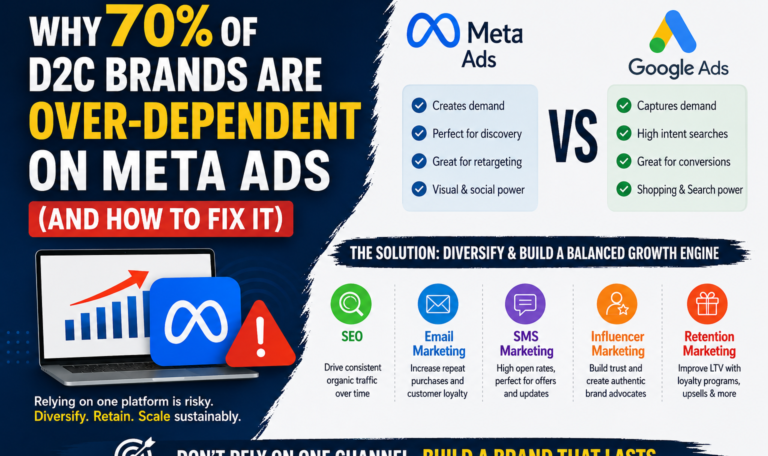
 Meta Ads have become the go-to growth channel for many D2C brands. Their advanced targeting, engaging ad formats, and quick results make them an attractive option for driving sales. However, relying too heavily on a single platform can put your business at risk.
Many successful D2C brands generate over 70% of their revenue from Meta Ads alone. While this may work initially, increasing ad costs, algorithm changes, and account restrictions can quickly impact profitability. A sustainable growth strategy requires a balanced marketing mix.
The Risks of Over-Reliance on Meta Ads
Depending solely on Meta Ads can create several challenges:
- Rising customer acquisition costs (CAC)
- Frequent algorithm updates affecting campaign performance
- Creative fatigue requiring constant new ad creatives
- Account suspensions or policy restrictions
- Limited tracking due to privacy updates like Apple’s ATT
If Meta is your only acquisition channel, even a temporary disruption can significantly affect your revenue.
Why Channel Diversification Matters
The strongest D2C brands don’t depend on one platform. They spread their marketing investment across multiple channels to reduce risk and improve long-term growth.
A balanced marketing strategy typically includes:
- Meta Ads – Generate awareness and demand.
- Google Ads – Capture high-intent buyers searching for your products.
- SEO – Drive consistent organic traffic without paying for every click.
- Email & SMS Marketing – Increase repeat purchases and customer loyalty.
- Influencer Marketing – Build trust and create authentic user-generated content.
Diversifying channels helps maintain steady sales even if one platform underperforms.
Google Ads vs. Meta Ads
Instead of choosing one over the other, use both strategically.
| Meta Ads | Google Ads |
|---|---|
| Creates demand | Captures existing demand |
| Best for discovery | Best for purchase intent |
| Great for visual storytelling | Great for high-converting searches |
| Excellent for remarketing | Ideal for Shopping and Search campaigns |
Together, they create a stronger customer acquisition strategy than either platform alone.
Don’t Ignore Retention Marketing
Acquiring customers is expensive. Keeping them is far more profitable.
Retention marketing helps increase Customer Lifetime Value (LTV) through:
- Welcome email sequences
- Abandoned cart recovery
- Post-purchase follow-ups
- Loyalty and rewards programs
- SMS promotions
- Personalized product recommendations
Improving repeat purchases often delivers a better return than continually increasing ad spend.
Build a Sustainable Growth Engine
Instead of relying on Meta for nearly all your revenue, aim for a diversified channel mix. For example:
- 35% Meta Ads
- 25% Google Ads
- 20% Organic SEO
- 10% Email & SMS
- 10% Influencers, Referrals & Other Channels
This approach reduces risk while creating more predictable, long-term growth.
Final Thoughts
Meta Ads remain one of the most effective channels for D2C brands, but they shouldn’t be your only growth engine. Combining Meta Ads with Google Ads, SEO, and retention marketing creates a more resilient and profitable business.
The brands that succeed in the long run are those that diversify acquisition channels, invest in customer retention, and focus on sustainable growth—not just short-term ROAS.
Frequently Asked Questions (FAQs)
1. Why are so many D2C brands dependent on Meta Ads?
Meta Ads offer fast customer acquisition, advanced targeting, and scalable campaign optimization, making them the default growth channel for many D2C businesses.
2. Is it better to use Google Ads or Meta Ads for D2C?
Neither is universally better. Meta Ads excel at creating demand, while Google Ads capture existing purchase intent. Using both together typically delivers stronger, more sustainable results.
3. What is the ideal marketing channel mix for a D2C brand?
While it varies by business, a balanced mix often includes Meta Ads, Google Ads, SEO, email marketing, SMS, influencer marketing, and referral programs so that no single channel dominates revenue.
4. Why is retention marketing important for eCommerce brands?
Retention marketing increases repeat purchases, customer lifetime value (LTV), average order value (AOV), and overall profitability while reducing dependence on paid acquisition.
5. Which metrics matter more than ROAS for D2C growth?
Brands should monitor Customer Acquisition Cost (CAC), Customer Lifetime Value (LTV), LTV:CAC ratio, Marketing Efficiency Ratio (MER), repeat purchase rate, branded search growth, and organic revenue to evaluate long-term business health.
