
 Not All Customers Are Worth the Same Acquisition Budget
Two customers can click the same ad, convert at the same price, and be worth entirely different amounts to your business. One repeats, refers friends, and rarely returns anything. The other buys once on a discount, sends half the order back, and never returns. Optimizing purely for ROAS treats both the same – which means brands are often paying to acquire customers who cost them money once returns are factored in.
Return rates hit profitability directly: every return erases the margin on that sale and adds processing cost on top. That’s why attracting the right customer matters more than attracting more customers, and why segmentation – grouping customers by value and return behavior – is one of the highest-leverage things a fashion brand can do with its marketing budget.
LTV, AOV, and Why LTV:CAC Beats ROAS
Customer Lifetime Value is the total profit a customer generates across their relationship with a brand — roughly average order value multiplied by purchase frequency and customer lifespan, adjusted for gross margin. It’s a different number from AOV, which only reflects a single order, and it changes the acquisition math: a customer with a modest AOV who buys four times a year and never returns anything can be worth more than a high-AOV customer who buys once and sends it back.
This is why LTV:CAC ratio is a better north-star than ROAS. ROAS measures what a single campaign generated; LTV:CAC measures whether the customers you’re acquiring are actually worth what you paid for them. A healthy benchmark sits around 3:1 – below that, acquisition is under real pressure; well above it, you may be under-investing in growth.
Why Fashion Returns Run So High
Apparel return rates are among the highest in ecommerce, driven by sizing uncertainty, color mismatch between photos and reality, fabric that doesn’t match expectations, impulse buying, and seasonal purchases made with less commitment than a considered buy. Every one of these is compressible with better information at the point of purchase – but from a segmentation standpoint, the more useful fact is that return behavior is predictable at the customer level, not just the product level. Some customers reliably return more than others, and that pattern is visible in the data before the next purchase happens.
The Segments Worth Acquiring More Of
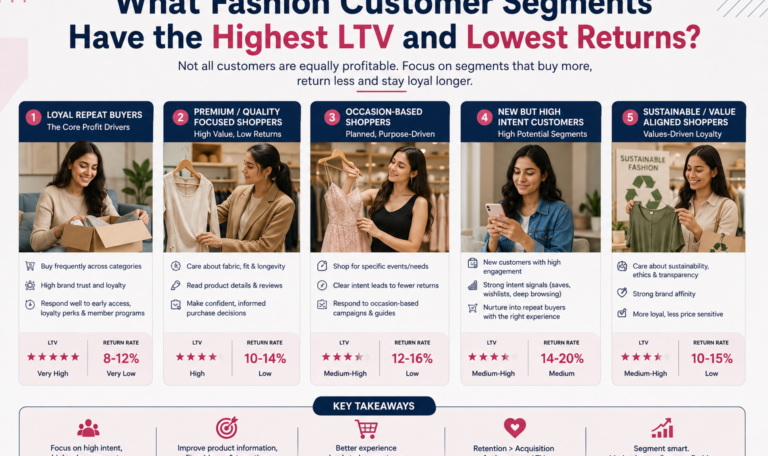
A handful of segments consistently show the combination of high LTV and low return rate that makes them worth extra acquisition budget:
- Repeat buyers and brand loyalists – already past the trust barrier, and their order history is a real signal of fit and satisfaction.
- Loyalty and VIP members – self-selected into a deeper relationship, with return rates that typically run below the general customer base.
- Capsule wardrobe and essentials shoppers – buying considered, fit-confident staples rather than trend impulse pieces.
- Personal styling and occasion-based customers – higher AOV, guided purchases with lower size-related return risk.
- Customers who use fit guides or size-recommendation tools before buying – resolving sizing uncertainty before the order, not after it.
These groups are more profitable for a simple reason: they buy with more certainty. Whether that certainty comes from experience with the brand, guided sizing, or considered (rather than impulsive) purchasing, it shows up directly as fewer returns and a longer relationship.
The Segments Worth Acquiring Less Of
On the other end, a few recognizable segments tend to produce disproportionate return volume relative to their value: discount-only buyers, flash-sale shoppers, first-time impulse buyers, customers who order multiple sizes of the same item to “try before keeping,” and trend-chasers buying on hype rather than fit confidence. This doesn’t mean excluding these customers entirely — some convert into loyal buyers over time — but it does mean acquisition spend shouldn’t scale blindly against them. Messaging aimed at these segments benefits from more explicit fit guidance and clearer return-policy framing, since uncertainty is usually the underlying driver of the behavior.
Building a Segmentation Model
A useful segmentation framework layers four types of data: demographic (age, gender, geography, income), behavioral (purchase frequency, browsing, return behavior), transactional (AOV, LTV, purchase interval, category mix), and psychographic (trend-driven vs. considered buying, sustainability or luxury orientation). Return rate deserves to sit alongside LTV as a primary segmentation axis, not a secondary flag — a segment with strong AOV but a high return rate can be less profitable than a modest-AOV segment that rarely returns anything.
Where AI Fits In
Predictive tools — GA4 predictive audiences, Klaviyo AI, Shopify’s built-in analytics, and Meta’s Advantage+ — can now estimate a customer’s likely LTV and return probability before a second purchase happens, based on early behavioral signals. That lets brands personalize offers and route acquisition budget toward likely-high-value segments earlier than waiting for a full purchase history to accumulate.
Turning Segments Into Media Buying: Meta and Google
Once segments are defined, they should shape targeting directly. On Meta, value-based lookalikes seeded from your highest-LTV customers — not just “purchasers” broadly — give the algorithm a much sharper signal to prospect against, and loyalty or VIP segments deserve dedicated retention campaigns rather than being folded into general remarketing. On Google, Customer Match built from high-LTV segments and value-based bidding strategies let campaigns optimize for expected customer value instead of simply maximizing conversion volume, which matters most in a category where not every conversion is equally profitable.
Retention and Product Strategy
Retention tactics — email and SMS flows, loyalty programs, early access, and personalized recommendations — compound most effectively when aimed at segments already showing high-LTV, low-return behavior, reinforcing a relationship that’s already working. On the product side, essentials, capsule collections, and repeat-purchase basics tend to generate the steadiest LTV, while highly trend-driven pieces bought on impulse tend to carry the highest return risk — a pattern worth reflecting in both merchandising and how those products are advertised.
Metrics Beyond ROAS
A fuller profitability picture tracks LTV and LTV:CAC ratio alongside repeat purchase rate, return and refund rate, gross margin, churn rate, and contribution margin. Together these show whether a campaign or segment is actually building durable profit, not just generating a transaction that looks good in the ad platform before the return arrives.
Common Mistakes
- Optimising acquisition purely for ROAS or conversion volume
- Treating all customers as equally valuable in campaign targeting
- Overspending to acquire discount-only or flash-sale shoppers
- Ignoring return behavior as a segmentation input
- Running generic remarketing instead of segment-specific messaging
The Sqroot High-Value Customer Framework™
This is the process we use to turn raw customer data into a profitability-based media strategy:
- Step 1 – Collect customer data across purchase, return, and engagement history
- Step 2 – Calculate LTV by segment
- Step 3 – Identify return patterns and their cost to margin
- Step 4 – Segment customers by value and return risk
- Step 5 – Create personalized campaigns for each segment
- Step 6 – Retarget high-value audiences with dedicated Meta and Google campaigns
- Step 7 – Reduce acquisition spend on high-return segments
- Step 8 – Grow loyalty and retention among the best-performing segments
Quick FAQs
Why is LTV more important than ROAS?
ROAS measures a single campaign’s attributed return; LTV:CAC measures whether the customers you’re acquiring are actually worth what you paid for them once repeat behavior and returns play out.
What customer segments have the lowest return rates?
Repeat buyers, loyalty members, and customers who use fit guides or size-recommendation tools before purchasing tend to show the lowest return rates, since they buy with more certainty.
How can AI predict customer lifetime value?
Tools like GA4 predictive audiences and Klaviyo AI use early purchase and engagement signals to estimate likely LTV and return probability before a full order history exists, letting brands act earlier.
