
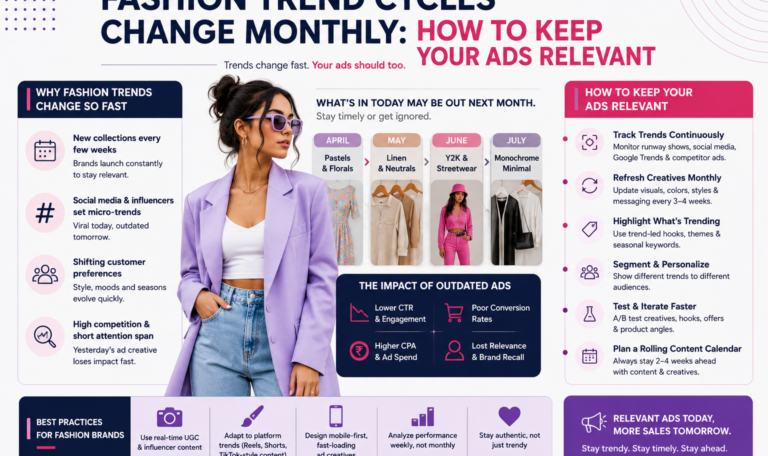
 Why Fashion Ads Go on Sale Faster Than Any Other Category
Fashion moves on a shorter clock than almost any other product category. A skincare routine or a kitchen appliance can sell on the same message for a year. A fashion ad built around a single “trending” look can lose relevance in a matter of weeks, because the trend itself has moved on. That mismatch a slow ad account trying to sell a fast-moving product is the single biggest reason D2C fashion brands watch ROAS climb for a month, then quietly bleed for two.
Trends shift quickly for three reasons: social platforms compress discovery cycles (a look can go from niche to saturated in days), influencers and creators seed new aesthetics constantly, and consumers now expect newness as a baseline, not a seasonal event. When a brand keeps running the same creative after the visual language around it has moved on, three things happen at once: the ad looks dated next to what’s in the feed, the audience has already seen it too many times, and the platform’s algorithm starts treating it as less relevant, which quietly raises CPMs even before CTR visibly drops.
This is why ad relevance has become a growth lever in its own right for fashion brands, not just a creative nice-to-have. The brands winning on Meta and Google right now aren’t necessarily spending more; they’ve built a system for staying current every month instead of relaunching from scratch every quarter.
Understanding the Fashion Trend Cycle
A trend cycle is the path a style takes from first appearance to mass adoption to decline. Historically, that cycle played out over one or two seasons. Social media has compressed it into weeks, sometimes days, for micro-trends, while broader style movements (like a color palette or silhouette) still play out over a season or two.
It’s worth separating three categories when deciding where to put ad budget:
- Micro-trends: fast, narrow, and short-lived – a specific styling detail or viral outfit combination. High engagement potential, short shelf life. Good for organic and quick-turn paid tests, risky as a long-running campaign anchor.
- Macro trends: broader shifts (a silhouette, a fabric, a color story) that hold for a season or more. These are worth building full campaigns and messaging around.
- Evergreen fashion: staples that don’t chase trend cycles at all. These deserve their own always-on campaigns that don’t need monthly creative overhauls, freeing up budget and team time to chase the faster-moving categories.
The practical rule: chase micro-trends with quick, low-production creative (often UGC or in-house content), invest real production budget in macro trends, and let evergreen products run on stable, optimized creative that only needs quarterly refreshes.
Why ROAS Declines: The Mechanics of Creative and Audience Fatigue
When performance drops on a previously winning ad, it’s rarely one thing – it’s a compound signal across three metrics moving together.
- Frequency: the average number of times a person has seen the ad. On Meta, a frequency above roughly 2.5–3.0 in prospecting campaigns is a common early warning sign; retargeting can tolerate more, typically up to 5–7, before it turns into fatigue.
- CTR decay: a meaningful drop from an ad’s peak CTR on a stable audience and budget signals the creative itself has stopped earning attention, independent of targeting.
- Rising CPM: platforms reward relevance. As engagement on a specific ad weakens, the auction prices it higher for the same reach, so cost climbs even when nothing else about the campaign has changed.
Creative fatigue and audience fatigue are related but different problems, and they call for different fixes. Creative fatigue means the audience still exists and would still buy – the current ad has simply become background noise. The fix is a genuinely new creative angle: a different hook, model, setting, or offer framing, not a caption swap. Audience fatigue means the pool of people you’re reaching is too small or too overlapped with other campaigns; the fix is expanding or resegmenting the audience, not just refreshing the ad.
As a general cadence, feed images and carousels tend to hold up for roughly two to four weeks before meaningful decay, while Reels and Stories fatigue faster – often inside one to two weeks at moderate-to-high spend. Treat these as upper bounds, not fixed schedules: the moment frequency, CTR, and CPM move together in the wrong direction, that’s the actual trigger to refresh, regardless of the calendar.
How to Track Fashion Trends Before Competitors Do
Waiting for a trend to show up in your own ad performance data means you’re already behind. A simple weekly scan across a handful of sources catches most shifts early enough to act on:
- Pinterest Trends and TikTok Creative Center for what’s rising in search and video content before it peaks.
- Meta Ad Library to see what competitors and adjacent brands are actively running right now, not just what they posted organically.
- Instagram Explore and fashion-week coverage for the aesthetic direction moving from runway into everyday content.
- Google Trends and your own Search Console data for rising product and style search terms in your specific market.
- Customer reviews and DMs, which often surface language and styling preferences before they show up anywhere else.
The goal isn’t to chase every signal. It’s to have a standing weekly habit of checking these sources so trend data feeds directly into what gets produced next, instead of creative decisions being made from instinct alone.
Building Trend-Responsive Ads Without Chasing Every Trend
Not every trend deserves a campaign. A trend earns ad budget when it fits the brand’s aesthetic, when there’s inventory to support it, and when it’s showing sustained (not single-day) momentum. Chasing every micro-trend blindly is one of the fastest ways to burn production budget on creative that never gets a fair test.
For the trends worth pursuing, speed matters more than polish. A same-week UGC-style video shot on a phone will usually outperform a beautifully produced ad that ships three weeks after the moment has passed. That’s why many fashion brands now run a mixed production model: quick-turn UGC and creator content for trend-responsive tests, and higher-production shoots reserved for evergreen and macro-trend campaigns that will run longer.
Across formats, a few tend to perform consistently well for fashion: Reels and short-form video for trend-driven discovery, Collection and Dynamic Product Ads for turning interest into purchase intent, and Carousel ads for showing how one trend translates across multiple products. Static ads still have a place for retargeting and lower-funnel audiences who already know the product.
Updating Messaging and Offers Every Month
Headlines and hooks that reference “new arrivals” or “trending now” age immediately and say nothing specific. Messaging that names the actual moment performs better and signals the brand is current. For example, instead of “New Collection,” a line like “Summer Linen Edit” ties directly to what’s trending. Instead of “Trending Dresses,” something like “Vacation Looks Everyone’s Wearing” borrows social proof language that mirrors how people actually talk about trends online.
Offers and urgency should follow the same monthly rhythm as creative – a limited-run framing for trend pieces (which genuinely do sell out or go out of style), versus value or loyalty-based messaging for evergreen staples where urgency would feel forced.
Audiences, Campaign Structure, and Budget
Audiences need the same monthly attention as creative. Interest targeting should be reviewed as trends shift the language people use to describe what they want, lookalikes should be refreshed off updated purchaser and engagement data rather than left static for months, and remarketing windows should reflect how fast the product itself moves – a trend piece needs a tighter retargeting window than an evergreen staple.
A workable campaign structure separates budget across a few clear buckets: new arrivals and trend tests, proven best sellers, seasonal or limited-edition drops, and an always-on evergreen campaign. Evergreen campaigns should keep running even while trend campaigns rotate constantly – they’re the stable base that funds experimentation elsewhere. As a starting allocation, many fashion advertisers keep roughly 50 – 60% of budget on proven evergreen and best-seller campaigns, with the remainder split between trend tests and seasonal pushes, shifting weight toward whatever is currently outperforming.
A Creative Testing Framework for Fashion
Consistent with the fatigue benchmarks above, a healthy testing cadence is 4–6 genuinely different creative angles in active rotation at any time, with 3–5 new concepts entering the pipeline each month for accounts spending at a moderate level. “Different” means a different hook, model, background, or offer – not five versions of the same shot with a new caption.
Useful variables to test include hook and opening frame, model and setting, background and colour story, offer framing, CTA wording, video length, and UGC versus professionally produced content. Let tests run long enough to reach a reliable read generally a minimum spend and a few days past the platform’s learning phase and cut a losing creative as soon as it’s statistically behind rather than letting it burn budget out of habit.
Google Ads and Meta Ads: What Should Change Monthly
Google Ads
- Refresh Search keywords and ad copy around newly trending product terms and seasonal language each month.
- Prioritize new arrivals and in-stock trend items in Shopping feeds; deprioritize or pause listings for items falling out of demand.
- Review Performance Max asset groups and swap underperforming assets rather than letting the campaign run unattended.
Meta Ads
- Feed Advantage+ Shopping and dynamic creative with fresh assets monthly so the algorithm has new material to test.
- Rotate catalog and collection ads to reflect current best sellers and trend pieces, not last month’s assortment.
- Revisit retargeting windows and lookalike sources as purchase and engagement data updates.
Retention: The Channel Most Fashion Brands Underuse
Trend-driven acquisition gets most of the attention, but existing customers are the highest-margin audience a fashion brand has, and they respond well to being told about a trend before it’s public. Email and SMS flows announcing early access to a trend drop, WhatsApp updates for VIP customers, and loyalty-tier exclusive launches all convert at a fraction of the cost of new-customer acquisition — and they reduce how hard the ad account has to work every month.
Metrics That Actually Matter
Platform-reported ROAS alone can be misleading in a fast-moving fashion account, since it doesn’t account for discounting, returns, or blended cost across channels. A more reliable read comes from tracking a fuller set together: ROAS and blended MER (marketing efficiency ratio) to see true return across all spend, CAC and AOV to understand real unit economics, CTR, CPC, CPM, and frequency to catch fatigue early, conversion rate to judge landing-page and offer strength, and LTV and repeat purchase rate to see whether trend-driven customers are becoming repeat ones. Optimizing for blended business metrics rather than platform-reported ROAS alone is one of the clearest ways to avoid decisions that look good in Ads Manager but don’t hold up in the P&L.
Common Mistakes That Kill Fashion Ad Performance
- Running the same creative for six-plus weeks because it once worked, past the point the data says it’s fatigued.
- Chasing every trend without checking fit, inventory, or sustained momentum first.
- Strong ads pointing to slow, generic, or poorly matched landing and product pages.
- Skipping UGC entirely and relying only on polished studio content, which increasingly reads as less authentic in fashion feeds.
- Treating all audiences the same instead of segmenting by trend interest, purchase history, and funnel stage.
The Sqroot Fashion Ad Refresh Framework
Winning fashion brands don’t wait for performance to drop before reacting — they run a standing monthly system that treats creative refresh as routine, not emergency. Sqroot’s framework breaks that system into four weekly stages:
- Week 1 — Trend Research: scan Pinterest, TikTok, Meta Ad Library, and search data; shortlist trends worth pursuing based on fit and momentum.
- Week 2 — Creative Production: brief and produce 3–5 new creative angles across a UGC/production mix, plus updated copy and offer framing.
- Week 3 — Launch & Test: launch new creative alongside existing winners, monitor frequency, CTR, and CPM daily during the learning phase.
- Week 4 — Scale Winners & Replace Fatigued Ads: reallocate budget to top performers, pause anything showing compound fatigue signals, and feed learnings into next month’s brief.
This Trend-to-Ad Pipeline is what separates brands that react to declining ROAS from brands that stay ahead of it – the system runs continuously, whether or not this month’s numbers are already slipping.
Monthly Fashion Ad Checklist
- Review trending styles across Pinterest, TikTok, and Instagram
- Audit what competitors are currently running in Meta Ad Library
- Refresh 3–5 creative angles across top campaigns
- Update headlines and hooks to reference current trends
- Launch new short-form video assets
- Refresh and resegment audiences and lookalikes
- Check Search Console and Google Trends for shifting demand
- Review blended ROAS, MER, and CAC, not platform ROAS alone
- Pause creatives showing compound fatigue signals
- Test at least one new offer or urgency angle
- Update landing pages to match current campaign messaging
FAQs
How often should fashion brands update their ads?
As a baseline, plan for new creative angles every two to four weeks, with Reels and Stories often needing refreshes closer to one to two weeks. The actual trigger should always be the data — frequency, CTR, and CPM moving together — not a fixed calendar.
What causes creative fatigue?
The same audience seeing the same ad enough times that they stop engaging with it. Platforms interpret that drop in engagement as reduced relevance and raise costs accordingly, even before the decline is obvious in daily reporting.
How can AI help fashion advertising?
AI tools can speed up trend detection, generate quick creative variations for testing, draft ad copy, and automatically test creative combinations at scale — mainly by shortening the time between spotting a trend and having a live, testable ad.
Why do fashion ROAS numbers decline even when nothing else changed?
Usually a compound of rising frequency, declining CTR, and rising CPM as an audience becomes saturated with the same creative — a normal part of the fatigue cycle, not a sign something is broken.
