
Every October, the same thing happens.
D2C founders scramble to pull together a Diwali sale. They slap a 20% discount on the store, increase Meta budgets on October 28th, watch CPMs triple overnight, and wonder why their ROAS dropped even though “everyone is buying.”
Meanwhile, the brands that genuinely scale during festive season started planning in July.
This is the difference. Festive season is not a week — it is a 90-day campaign. And the brands that treat it like one consistently outperform the rest, not because they have bigger budgets, but because they show up earlier, smarter, and with warmer audiences when CPMs peak.
Here is exactly how they do it.
The Indian D2C Festive Calendar — What You’re Actually Working With
Before the playbook, get the calendar right. India’s festive season isn’t one event — it’s a sequence:
| Window | Dates (approx.) | Relevant D2C Categories |
|---|---|---|
| Ganesh Chaturthi | Aug 22 – Sep 1 | Home décor, sweets, apparel (Maharashtra-heavy) |
| Navratri | Oct 2–12 | Ethnic wear, fashion, footwear, jewellery |
| Dussehra | Oct 12 | Gifting, home, fashion |
| Dhanteras | Oct 28 | Jewellery, electronics, home, cookware |
| Diwali | Oct 29 – Nov 2 | Everything — peak of peaks |
| Bhai Dooj | Nov 3 | Gifting, fashion, personal care |
| Christmas | Dec 25 | Gifting, lifestyle, premium D2C |
| New Year | Dec 31 – Jan 1 | Wellness, fitness, apparel (new year, new me) |
For most D2C brands, the window from Navratri through Diwali is the highest-revenue stretch of the year. For wellness, nutrition, and fitness brands, New Year is equally important.
The mistake is treating each of these as a separate, isolated sale. They are chapters in the same story. Customers who engaged with your Navratri campaign are your warmest audience for Diwali. Customers who bought at Diwali are your highest-LTV retargeting pool for New Year. Build the audience once. Monetise it across the full sequence.
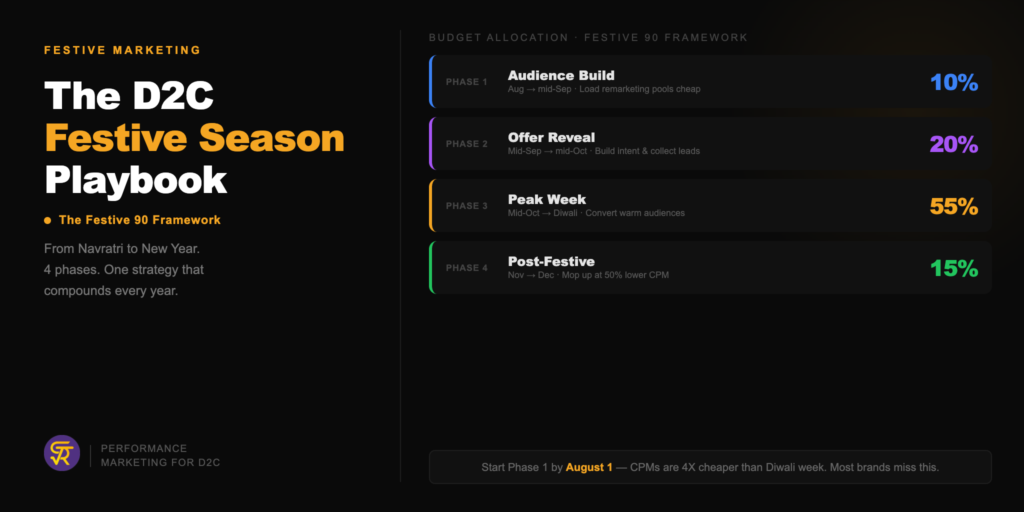
The Festive 90 Framework — 4 Phases
Phase 1: The Audience Build (90–45 Days Before Diwali | August – Mid-September)
This is the most important phase. It is also the cheapest, because you are building audiences before the CPM spike arrives.
Your only goal in Phase 1 is to load your remarketing pools.
You are not selling yet. You are building the audience that you will convert in Phase 3. Every rupee spent in Phase 1 reduces your effective CAC in Phase 3, because you are reaching the same people at a fraction of the cost before festive demand inflates prices.
What to run:
- Video content campaigns on Meta — 15–30 second videos showing product stories, behind-the-brand content, UGC compilations. Optimise for ThruPlay, not conversions. These are cheap. You are building video viewer audiences.
- Blog and educational traffic campaigns — “Diwali gifting guide,” “How to choose [your category] for gifting.” Send this traffic to your website. Meta will cookie these visitors.
- Pinterest and YouTube — early-stage festive research happens here 60–90 days before Diwali. Get there before competition does.
- WhatsApp opt-in campaigns — run a “Register for Diwali Early Access” lead capture ad. WhatsApp subscribers cost ₹8–15 to acquire in Phase 1 vs. ₹40–80 during peak week. Build the list now.
KPI for Phase 1: Size of remarketing pools — website visitors, video viewers, email and WhatsApp opt-ins. You are not measuring ROAS here.
Phase 2: The Offer Reveal (45–15 Days Before Diwali | Mid-September – Mid-October)
Your Phase 1 audience is now warmed. This is when you shift from awareness to intent.
Your goal in Phase 2: move warm audiences to active consideration and collect data.
- Early access campaigns — “Join our Diwali early access list and get first dibs + flat ₹200 off.” This converts warm audiences into high-intent leads before peak week CPMs arrive.
- Wishlist campaigns — if your platform supports wishlists, run a “Build your Diwali wishlist” campaign. Wishlist adders are your highest-intent remarketing audience. They’ve told you exactly what they want.
- Google Shopping — start bidding on festive-intent keywords: “Diwali gift for [category],” “ethnic wear Navratri,” “home décor Diwali.” These keywords are cheap and high-converting in Phase 2. By Phase 3, competitors have bid them up.
- Influencer seeding — send PR packages now. Influencer content takes 10–14 days to publish. You want influencer reviews and “Diwali haul” content going live in Phase 3, not Phase 2. Seed in Phase 2, harvest in Phase 3.
What not to do in Phase 2: Launch your final Diwali offer. If you show a 30% discount in September, you have nowhere to go in October — and you’ve trained your audience to wait for sales.
Phase 3: Peak Week Execution (15 Days Before Diwali Through Diwali | Mid-October – November 2)
This is the phase everyone focuses on. It is important — but the brands that dominate Phase 3 only do so because of the work in Phases 1 and 2.
Your goal: convert the audiences you built over the previous 60 days.
Deploy 55% of your total festive budget in this phase. On Meta, expect CPMs to be 2.5–4X higher than normal in the final 5 days before Diwali. The advantage you have over brands starting now is that your retargeting audiences are full — you are not running cold prospecting at 4X CPM. You are remarketing to people who already know you.
Campaign structure for Phase 3 on Meta:
- Retargeting stack — website visitors (30 days), video viewers (75%+), wishlist adders, early access sign-ups. Run these at uncapped budget with your best creative. These audiences convert at 3–5X the rate of cold traffic.
- Lookalike from Phase 1 opt-ins — 1–2% lookalike of your Diwali early access list. This is the most qualified cold audience you have.
- Broad prospecting with Advantage+ — only if you have 50+ purchases/week. Let the algorithm find new buyers using your customer list as a signal. Set a spend cap so it doesn’t eat your retargeting budget.
Creative strategy for Phase 3:
- Use social proof creatives — “2,000 orders shipped this Diwali season.” Scarcity and social proof outperform discounts at this stage.
- Urgency through real delivery windows — “Order by Oct 28 for delivery before Diwali.” Link it to actual courier cutoffs.
- Run 3–4 creative variations simultaneously — festive CPMs cause creative fatigue 40% faster than normal months. Rotate creatives every 3–4 days.
- Reels outperform static in Phase 3 — festive-themed 15-second videos consistently deliver 20–30% lower CPC than static images during Navratri–Diwali.
What not to do in Phase 3: Don’t launch a new creative in the last 7 days before Diwali — Meta needs 3–5 days of learning phase. Don’t pause campaigns during 48-hour CPM spikes — that is peak buying intent, not a time to go dark. Don’t lead with discount-only messaging — Diwali is India’s peak gifting season and buyers already intend to spend.
Phase 4: Post-Festive Monetisation (Diwali + 30 Days | November 3 – December 2)
This is the phase 90% of D2C brands completely ignore. It is also where some of the best ROAS of the festive window is available.
Why Phase 4 works:
- CPMs drop 40–60% the week after Diwali
- Buyers received gifts, gift cards, and Diwali bonuses — disposable income is high
- Many buyers browsed your store during peak week but didn’t convert. They are now reachable at lower cost.
- Non-buyers who saw your ads 15+ times during peak now have weaker resistance. A softer “New Arrivals” message converts a meaningful portion.
What to run in Phase 4:
- “Gifting gap” campaigns — “Didn’t find what you were looking for during Diwali? Our new collection just dropped.” Cash-gift recipients are in active spending mode.
- Post-Diwali clearance + new arrivals mix — the clearance item drives the click; the new arrival captures full-margin revenue.
- Re-engage Phase 3 non-converters — everyone who visited, added to cart, or watched your video in Phase 3 but didn’t buy. Your cost to reach them is now 50% lower.
- Bhai Dooj, Christmas, New Year campaigns — you are not starting cold. You are re-activating the same audience that engaged with your Diwali campaign.
Budget Allocation Across the Festive 90
| Phase | Timing | % of Festive Budget | Primary Goal |
|---|---|---|---|
| Phase 1 — Audience Build | Day -90 to -45 | 10% | Load remarketing pools |
| Phase 2 — Offer Reveal | Day -45 to -15 | 20% | Build intent, collect leads |
| Phase 3 — Peak Week | Day -15 to Day 0 | 55% | Convert |
| Phase 4 — Post-Festive | Day 0 to +30 | 15% | Mop up at low CPM |
Most D2C brands spend 80% of their festive budget in Phase 3 alone and skip Phases 1, 2, and 4. They then complain about high CPMs and low ROAS. Brands spending across all four phases report 35–45% higher total revenue from the festive window on the same total budget.
WhatsApp: Your Highest-ROI Festive Channel
WhatsApp delivers the highest festive conversion rate at the lowest cost-per-result — because you own the list and you’re not bidding against competitors.
If you built a WhatsApp opt-in list in Phases 1 and 2, here is how you activate it:
- D-14 before Diwali: Broadcast your “Diwali Gift Guide” — a curated carousel of your top gift picks under ₹500, ₹1,000, ₹2,000. No discount. Pure gifting utility.
- D-7: “Early access opens tomorrow” — builds anticipation.
- D-6: Early access link, exclusive to WhatsApp subscribers.
- D-5 to D-2: Daily broadcast with a specific product highlight and countdown.
- D-1: Last delivery window reminder — “Order by 6 PM today for pre-Diwali delivery.”
- D+3 (post-Diwali): “Thank you + New arrivals” — reactivation message.
Cart abandonment during festive: Reduce your recovery delay from 24 hours to 1 hour. Buyers during festive season are context-switching rapidly between brands. A 1-hour WhatsApp cart recovery message during Diwali week recovers 2–3X more carts than normal months.
Platform-Specific Notes
Meta: Your best Phase 3 investment is retargeting — not prospecting. If you have less than ₹3 lakh/month total ad spend, put 70% of Phase 3 budget into retargeting. Prospecting at 4X CPM during Diwali with small audiences is a low-ROAS play.
Google Shopping: Start bidding on “gift for [category]” and “Diwali [product]” keywords from October 1. These keywords convert at 3–5X the rate of generic product keywords during festive, and CPCs are lower before Diwali-week bidding wars begin.
YouTube: Not a direct ROAS channel during festive. Run 15-second non-skippable bumper ads targeting competitor audiences for brand recall. Budget: ₹5,000–10,000. The return is visibility and search brand lift, not attributed conversions.
Frequently Asked Questions
When should a D2C brand start planning for Diwali?
The audience build (Phase 1) should start by August 1 for peak Diwali performance. Brands starting in October are competing for audiences that other brands already warmed up for two months. The earlier your start, the cheaper your ultimate conversion.
How much should I increase my Meta budget during festive season?
Plan for Phase 3 budgets to be 2.5–3X your normal monthly run rate. However, stack the increase across phases — don’t triple the budget only in peak week. Spreading across the 90-day window delivers significantly better overall ROAS than a single peak-week spike.
What’s a realistic ROAS target during Diwali week on Meta?
Expect your CPM-adjusted ROAS to be 15–25% lower than your normal month ROAS during the last 5 days before Diwali, even with a warm audience. CPMs triple; conversion rates improve but don’t fully offset. Your overall festive window ROAS averaged across all four phases should exceed your normal month ROAS if you run the full framework.
Should I offer a Diwali discount, or can I sell at full price?
This depends on your category. Gifting categories — personal care, home décor, accessories, apparel — can sell at full price with strong gifting creative. Commodity-adjacent categories generally need a discount to differentiate. Ask yourself: is your buyer in gifting mode or personal purchase mode? Gifting mode tolerates full price; personal purchase mode responds to discounts.
How do I avoid creative fatigue in a 90-day festive campaign?
Plan your creative calendar in phases: Phase 1 uses brand storytelling content. Phase 2 uses product feature and gifting utility content. Phase 3 uses offer, social proof, and urgency content. Phase 4 uses new arrivals and post-festive value content. Build separate creative sets for each phase — don’t run the same Diwali ad from August through November.
Is Ganesh Chaturthi worth advertising for, or is Diwali sufficient?
Ganesh Chaturthi is a strong Phase 1 trigger for Western India audiences. Running a Ganesh Chaturthi campaign as an audience-building exercise — even without a major sale — warms your Maharashtra audience pool at very low cost, making them cheaper to convert during Diwali. Think of it as free Phase 1 audience building with a cultural hook.
Running festive campaigns without a 90-day framework is like opening a Diwali gift shop on October 30th — you’ve already missed the setup. At Sqroot, we plan D2C festive campaigns from Phase 1 through Phase 4, so our clients are converting warm audiences while competitors are paying 4X CPM for cold traffic. Book a free festive strategy session before August — that’s when Phase 1 should start.
